Free public course · 29/40
Chapter 29: The Outer Knowledge Loop
Lesson objectives
Required artifact: outer knowledge-loop ledger
O1 · Can trace the forward and feedback paths among field discovery, product feedback and reusable asset (artifact: outer knowledge-loop ledger)
Evidence: The outer knowledge-loop ledger draws both a forward path and a return path across field discovery, product feedback and reusable asset
O2 · Can construct a outer knowledge-loop ledger with the input, decision and write-back evidence for every pass (artifact: outer knowledge-loop ledger)
Evidence: Every stage in the outer knowledge-loop ledger states its input, decision, output and owner
O3 · Can turn a field discovery into product feedback and a reusable asset (artifact: outer knowledge-loop ledger)
Evidence: The artifact records one discovery, product decision, reuse condition and non-generalization boundary
Before this lesson: Chapter 28: Stakeholders and Embedded Collaboration
Novice path
Chapter transfer task: Can turn a field discovery into product feedback and a reusable asset. Use the diagram's loop relationship to complete the first evidence item in the outer knowledge-loop ledger, then check each owner and decision rule.
Experienced path
Apply this task to a current project before reading the explanation: Can turn a field discovery into product feedback and a reusable asset. Submit the outer knowledge-loop ledger, then check the relationship type, missing evidence and authority boundary.
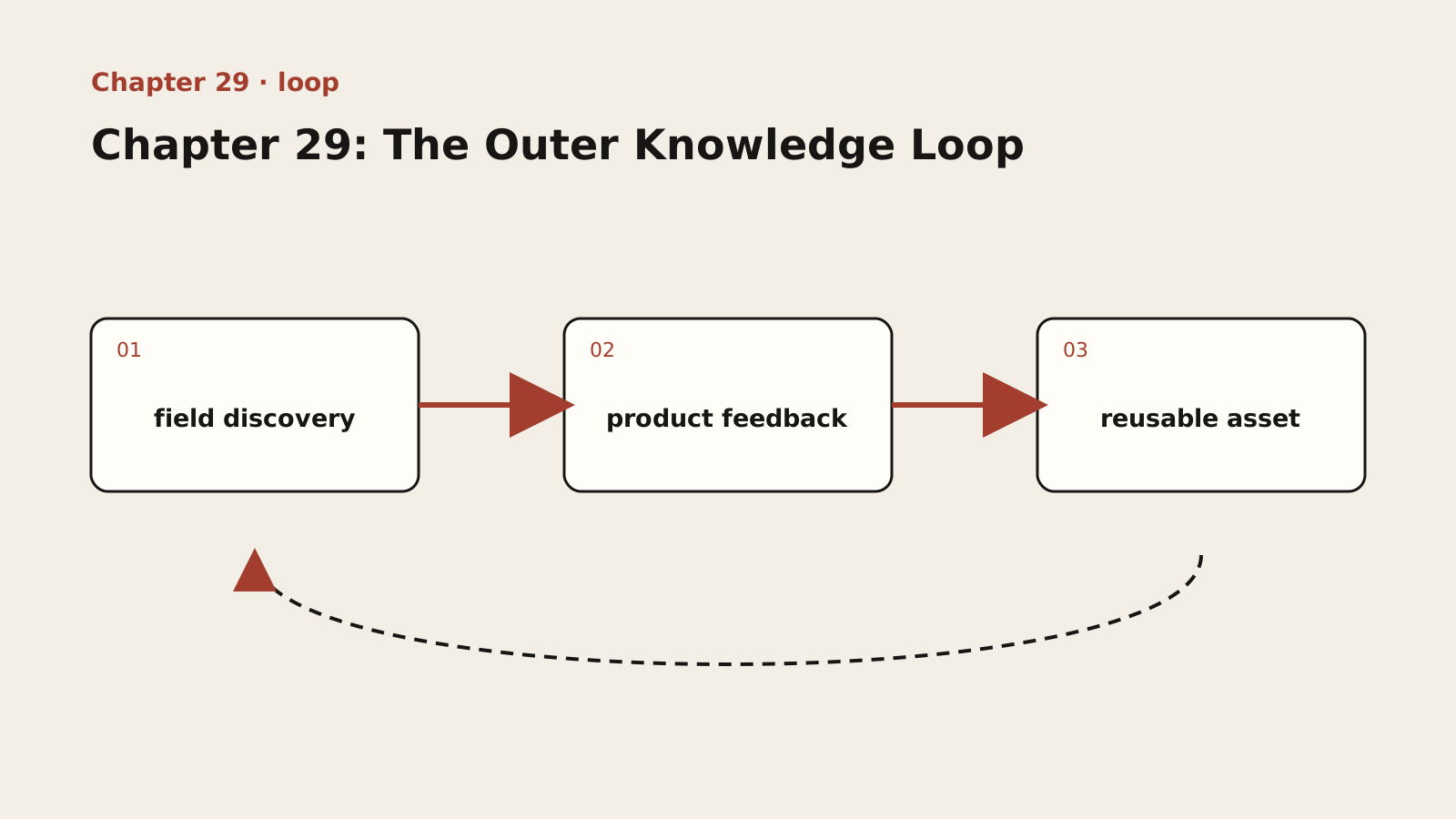
Diagram text description
The diagram moves forward from field discovery through product feedback to reusable asset, then returns by a dashed path. Forward arrows produce a result; the return path carries observation and correction. If results do not alter the next input, this is a one-way flow rather than a loop.
Relationship semantics: Three stages produce a result along the forward path, then observations return to change the next input; without write-back there is no loop.
Adapted public course. Concepts, procedures and examples are adapted from the internal textbook. Case sizes, timings, improvement figures and target thresholds are illustrative, not site delivery results or universal standards. Verify tools, platforms and skills in your environment. Prompts do not grant permissions and retry counts do not authorize recovery. Preserve work and verify targets, sharing and external-state effects first.
Lesson explanation
29.1 Codify Field Patterns into Reusable Building Blocks
Chapter 28 covered decisions and people at the customer site. This chapter asks what happens afterward: how to turn field learning into team assets rather than let it age in your notebook.
Consider a teaching scenario. Three weeks into an engagement, you discover that the customer’s database field names differ completely from the documentation. Mapping them takes two days. Three months later, a colleague at another customer encounters almost the same problem and spends another two days. You work for the same company and sit in the same meeting room, unaware of the shared experience. The problem is knowledge without an outer loop: field experience stays in individual minds instead of reaching the next person who needs it.
OpenAI’s FDE job description states the responsibility directly: “Codify working patterns into tools, playbooks, or building blocks that others can use.” This is a key boundary between FDE and senior outsourced on-site work. The latter delivers results at the customer site; the former also returns experience to the team and product.
Three forms of codification. The following categories and rules are this book’s teaching method. They distinguish automation levels, not inherent value:
| Form | Applies when | Example artifacts | Maintenance cost |
|---|---|---|---|
| Tool | A validated pattern can be automated | Data-source discovery script, automated eval runner, customer-environment diagnostic tool | High: engineering maintenance |
| Playbook | Human judgment is needed but the process can be standardized | Scoping interview checklist, stakeholder engagement manual, pre-launch self-check | Medium: periodic updates |
| Template | A document or record can use a stable structure | Scoping report, customer ADR, readout template | Low: occasional iteration |
The forms can develop into one another. Start with a template: Chapter 28’s authority matrix and customer ADR structure can simply be filled in on the next project. When recurring judgment points emerge, promote them into a playbook, such as the N things to do in the first 48 hours with a particular type of customer. When a playbook step proves mechanically repetitive, extract a tool.
A practical selection rule is make it a candidate on the second occurrence. If a data-conversion workaround appears at two customer sites, compare its commonalities and differences. Frequency is only a clue; a first high-risk failure also deserves immediate recording. Before publishing a building block, document conditions, inputs, outputs, verified environments, and exclusions. Have a colleague outside the original project try it with de-identified examples. Mark it usable only after reproduction succeeds; otherwise improve the boundaries or retain it as an unverified note. The opening field-name issue should become a discovery and mapping-verification process, not one customer’s mapping copied into another customer’s system.
Two codification disciplines.
First, retain the field context. A common failure is overdoing abstraction: living experience becomes dry procedure resembling a factory manual nobody consults during an actual problem. A useful playbook sounds like an experienced colleague: “You will meet this on day three; here are the three steps.” Preserve concrete situations and actual judgments rather than removing all context.
Second, name an owner and an update cadence. Every block should identify its owner, version, latest verification date, and failure-feedback channel. Review quarterly, or earlier when relevant interfaces or models change. Update applicable assets, mark invalid ones withdrawn with an alternative route, and archive those not worth maintaining. Chapter 34 embeds ownership in the optimization phase. Handing over an asset includes handing over maintenance information.
29.2 Feedback to Product and Model Teams: Readouts with Eval Evidence
Codification moves knowledge from you to teammates. Another channel moves it from the field toward product and model evolution.
Many FDEs see themselves as delivery people, preserving experience inside the team while the path to product stops. Their responsibility also includes turning field-validated product and model weaknesses into actionable product feedback. OpenAI’s FDE-team job description includes the quality of eval-driven feedback to Product and Research among success measures, as cited in Chapter 23.
The key is eval-driven: bring evaluation data, failure cases, and quantitative evidence that lets recipients reproduce the issue.
The readout format. Chapter 23 established the trigger matrix, locked baselines, and four decision exits. Its inner loop supports your own decisions; the outer loop packages evidence into a readout product teams can consume.
This book defines a readout as a structured feedback document, whether email or shared document. The following is a teaching hypothetical; its cases and numbers do not represent real customers or model performance:
| Element | Meaning | Example |
|---|---|---|
| Field facts | What happened and what the customer said | The customer’s clinical team says medical-summary abbreviation expansion is insufficiently accurate |
| Eval evidence | Numerators, denominators, and versions under fixed definitions | Golden set v3, judge v2, matching run definitions: baseline configuration passes 54/60, new configuration 40/60; attach configuration versions and rerun records |
| Failure pattern and untested attribution | Separate observation from causal hypothesis | Some abbreviations expand into unsupported terms; a missing domain dictionary is an untested hypothesis, not an established model root cause |
| Affected scope | State sample scope and business obstacle | This set specifically covers abbreviations and does not estimate the error rate for all medical records; affected summaries require human review |
| Recommendation | An executable next step for the recipient | Ask the product owner to arrange a controlled dictionary-constraint experiment, decide using Chapter 23’s five dimensions, and attach a minimal de-identified reproduction |
Readout cadence. Feedback is continuous across the lifecycle, not an end-of-project memoir. Three fixed points are useful:
- End of scoping: a first-impressions readout covering data state, customer constraints, and gaps in product coverage. Real environmental information is valuable for product prioritization.
- Mid-validation: an eval-improvement readout with the five dimensions from Chapter 21, the baseline gap, and the largest regressing category. Product teams need to know precisely where models fall short in actual scenarios.
- Delivery closeout: a production-performance readout with Chapter 26, Section 26.3’s production adoption data, user behavior, and newly exposed failure modes. Distinguish observation windows from formal metrics: records from fewer than 30 days after launch are interim observations, not the defined 30-day adoption rate.
These are the book’s suggested timings. If scoping has no evals yet, label findings as hypotheses awaiting validation. Escalate major failures promptly through the project channel while preparing the readout. Before sending anything to product or model teams, confirm disclosure scope, recipients, and data destinations under Chapter 28’s authority matrix. De-identification does not automatically grant permission. Where raw samples cannot leave, provide an authorized synthetic reproduction or verify inside the customer’s environment.
Maintain the channel itself. Record a receiving owner, decision needed, agreed response date, and status for each readout. If product declines a change for now, preserve the reason and field workaround. After an accepted change, the FDE revalidates under matching definitions and updates the customer. If a second customer has a similar issue, add evidence with compatible boundaries; customer count alone does not establish a shared root cause. The loop closes when conclusions return, not when a document is sent.
29.3 Team Mechanisms: From Personal Habit to Organizational Capability
The preceding sections describe two individual responsibilities: codify building blocks and give product teams eval-backed feedback. Relying on personal initiative produces predictable results: the strongest people sometimes do it, others never do, and team knowledge stays fragmented.
Three team mechanisms turn habit into organizational capability. Chapters 34 and 35 cover their institutional details — setup, operation, and integration into team onboarding — including bootcamp construction in the optimization phase and the transition from one-off courses to regular operations. Here we explain what they are, why they matter, and the individual FDE’s responsibilities.
Mechanism one: Field Notes. A team channel or internal document space provides a shared entry point. Record one fact, its applicable context, an evidence link, and whether it remains unverified. Only authorized material enters the appropriate permission-controlled space. An internal channel does not automatically permit disclosure of raw customer data or private information. The individual records accurately and answers follow-up questions; a rotating maintainer groups related entries. Somebody must compare and validate patterns. Accumulating notes alone does not establish them.
Mechanism two: fortnightly sharing. Peers question field notes: can the evidence be rerun, does the finding hold at another customer, what conditions were omitted? FDEs take turns presenting one finding and its failure boundary, including problems trying another person’s building block. Each session should leave a conclusion or validation task; retain unresolved disagreements. Chapter 35 provides scheduling, duration, and archive templates. Here the responsibility is participation with evidence, beyond progress reporting.
Mechanism three: bootcamp training. Concentrated practice calibrates judgment on shared cases: can people reproduce failure, use a building block to solve it, and name where reuse fails? According to The Pragmatic Engineer’s August 2025 interview with OpenAI’s FDE leader, the team exchanges knowledge through quarterly bootcamps, fortnightly sharing, and Field Notes. What this book borrows is the ongoing exchange mechanism. Suggested training lengths, operations, and increases in frequency are teaching designs. After training, FDEs return trial issues to asset owners and record results in the next project. Chapter 35 covers organizers’ topic selection and acceptance.
The mechanisms form a pipeline from fragments to shared understanding: Field Notes collect raw material; fortnightly sharing performs initial processing; bootcamps refine and deliver it. Individuals contribute notes regularly, take turns sharing, and bring calibrated practices back from bootcamps. Chapter 34 embeds these duties in the onboarding roadmap’s optimization phase; Chapter 35 details operations. The outer knowledge loop is part of FDE work, not an extra task.
[Self-Check] Has Knowledge Actually Flowed Outward?
- Does the building block have applicability boundaries, a reproduction example, a version, and an owner?
- Are readout numbers based on comparable baselines, separating facts from root-cause hypotheses?
- Are shared content and recipients within customer authorization?
- Is somebody receiving and following up on feedback, with changes returned to the field for verification?
[Exercise] Put the Dental-Clinic Project into the Outer Knowledge Loop
Task: Continue the fictional clinic project from Chapters 27 and 28 in delivery week three. Teaching assumptions: (1) an ADR and proposal email exist; (2) on the same-version set of 100 terminology cases, the new configuration produces 18 unsupported expansions versus 6 for the baseline, with golden set, judge, and run definitions fixed; (3) the IT lead privately disclosed a compatibility issue, but disclosure to product is not yet authorized. Produce a five-element readout, a Field Note of no more than three sentences, and a five-minute bootcamp sharing outline. State evidence versions, untested hypotheses, recipient, next follow-up date, and disclosure boundaries. Mark missing information as outstanding; do not invent authorization or a confirmed root cause.
Guidance: Practice three transformations. First, turn observation into reproducible evidence: 18/100 describes this set, not all medical-record risk, and proves no root cause. Second, turn an individual case into a candidate pattern: design a controlled experiment on whether dictionaries or context affect unsupported expansion. Third, place the candidate in an ongoing mechanism: who adds evidence after sharing, when is it reviewed, and what result would justify publishing a playbook?
Reference direction for instructors: Assess comparability, separation of fact and hypothesis, sharing permission, and follow-up ownership. A Field Note should lead colleagues to evidence, not copy an entire readout. The training outline should include reproduction and boundary discussion. Even a useful compatibility issue needs verification and disclosure permission first. Until authorized, follow up only within the customer’s approved space; do not put private information in an all-hands channel.
Sources for the industry facts in this chapter: The English quotation on codifying working patterns into tools, playbooks, and building blocks comes from OpenAI’s public FDE job description. Eval-driven feedback as a success measure follows the FDE-team job description cited in Chapter 23. Quarterly bootcamps, fortnightly sharing, and Field Notes come from The Pragmatic Engineer’s August 2025 interview with OpenAI FDE leader Colin Jarvis, reusing industry material already verified for this book. Categories, maintenance rules, the readout’s five elements and timings, and exercise data are teaching designs, not a particular company’s internal workflow or measured results.
Part Nine is complete. Chapter 27 provided the three-phase customer rhythm and a unified mapping of four process models. Chapter 28 covered layered stakeholder collaboration and bounded autonomy under ambiguous authorization. This chapter returned field experience through the outer knowledge loop: reusable building blocks, eval-backed product feedback, and team mechanisms that turn individual discoveries into organizational capability. One thread connects them: the endpoint is a real change in the customer’s workflow, with experience helping the next customer change faster. Chapters 30-33 turn to team collaboration and delivery culture: async first, high trust, high autonomy, and the task lifecycle. That operating foundation for working with your own team complements this part’s customer collaboration.
Independent exercise
Use fictional or authorized deidentified material. Answer independently before revealing the reference. Save chapter-29.md with versions, decisions, evidence and gaps.
From an unknown-category error, derive a template, tool and product requirement with sharing review, owner, version and reuse checks.
Required chapter artifact: outer knowledge-loop ledger
The submission for this independent exercise must contain the evidence below. The existing prompts supply content but do not replace these acceptance items.
- O1: The outer knowledge-loop ledger draws both a forward path and a return path across field discovery, product feedback and reusable asset
- O2: Every stage in the outer knowledge-loop ledger states its input, decision, output and owner
- O3: The artifact records one discovery, product decision, reuse condition and non-generalization boundary
Reveal reference feedback (answer first)
Reference feedback
The template asks about unknown handling, the tool checks refusal to guess, and the product request identifies a repeated constraint with authorized evidence. Remove identifiers and confirm sharing rights; deidentification alone does not authorize publication. Validate reuse in another task.
Self-review and next steps
Check whether your decision is explicit, evidence reproducible and unknowns honestly recorded. The reference illustrates one defensible approach, not a unique answer. Seek peer review for alternatives with equivalent evidence. Mark unsupported parts unfinished and revisit the corresponding step.
Sources and boundaries
Registered sources support only the external claims used here. The outer knowledge-loop ledger, example numbers and exercise scenario are internal instructional design and require project-specific validation.
- Forward Deployed Engineer role — San Francisco
OpenAI · 2026-09-28 · This OpenAI role covers discovery, scoping, design, build, rollout, adoption and field feedback; it is not an industry-wide standard.
- FDE origins, role distinctions and OpenAI work phases
The Pragmatic Engineer · 2026-09-17 · This interview reports FDE origins, OpenAI SA/FDE distinctions, three customer-project phases and team knowledge-sharing cadences; it is secondary interview evidence, not an industry standard.
Record lesson practice
Only a browser self-check is saved. No work is uploaded, reviewed or certified. Keep evidence and gaps in your own chapter file.